Indexer Pipeline Architecture
sui-indexer-alt-framework는 두 가지 고유한 파이프라인 아키텍처를 제공한다. 올바른 접근 방식을 선택하기 위해 이들의 차이점을 이해하는 것이 중요하다.
Sequential versus concurrent pipelines
Sequential pipeline 은 완전한 체크포인트를 순서대로 커밋한다. 각 체크포인트는 다음 체크포인트가 처리되기 전에 완전히 커밋되어 단순하고 일관된 읽기를 보장한다.
Concurrent pipeline 은 순서와 관계없이 커밋하며 개별 체크포인트를 부분적으로 커밋할 수 있다. 이를 통해 여러 체크포인트를 동시에 처리하여 더 높은 처리량을 달성할 수 있지만, 일관성을 보장하기 위해 어떤 데이터가 완전히 커밋되었는지 읽기 작업에서 확인해야 한다.
When to use each pipeline
두 파이프라인 유형 모두 제자리 업데이트, 집계 및 복잡한 비즈니스 로직을 처리할 수 있다. 시퀀셜 파이프라인은 컨커런트 파이프라인에 비해 처리량 제한이 있지만, 둘 중 하나를 선택하는 결정은 성능 요구사항보다는 주로 엔지니어링 복잡성에 관한 것이다.
Recommended: Sequential pipeline
대부분의 사용 사례에서 여기서 시작한다. 더 직관적인 구현과 유지보수를 제공한다.
- ✓ 직접적인 커밋과 간단한 쿼리로 직관적인 구현을 원한다.
- ✓ 팀이 예측 가능하고 디버깅하기 쉬운 동작을 선호한다.
- ✓ 현재 성능이 요구사항을 충족한다.
- ✓ 운영의 단순성을 중시한다.
concurrent pipeline
다음과 같은 경우 concurrent pipeline 구현을 고려한다:
- ✓ 성능 최적화가 필수적이다.
- ✓ 시퀀셜 처리가 데이터 볼륨을 따라갈 수 없다.
- ✓ 팀이 성능 이점을 위해 추가적인 구현 복잡성을 처리할 의향이 있다.
순서와 관계없는 커밋을 지원하면 파이프라인에 몇 가지 추가 복잡성이 생긴다:
- Watermark 인식 쿼리: 모든 읽기는 어떤 데이터가 완전히 커밋되었는지 확인해야 한다. 자세한 내용은 the watermark system 섹션을 참조한다.
- 복잡한 애플리케이션 로직: 완전한 체크포인트를 처리하는 대신 데이터 커밋을 조각 단위로 처리해야 한다.
Decision framework
프로젝트에 어떤 파이프라인을 선택해야 할지 확실하지 않다면 구현과 디버깅이 더 쉬운 sequential pipeline 으로 시작한다. 그런 다음 현실적인 부하에서 성능을 측정한다. sequential pipeline 이 프로젝트 요구사항을 충족할 수 없다면 concurrent pipeline 으로 전환한다.
전체 목록은 아니지만 시퀀셜 파이프라인이 요구사항을 충족하지 못할 수 있는 몇 가지 구체적인 시나리오는 다음과 같다:
- 파이프라인이 각 체크포인트에서 청킹과 순서 무관 커밋의 이점을 얻는 데이터를 생성한다. 개별 체크포인트는 많은 데이터나 지연 시간을 추가할 수 있는 개별 쓰기를 생성할 수 있다.
- pruning이 필요한 많은 데이터를 생성하고 있다. 이 경우 컨커런트 파이프라인을 사용해야 한다.
어떤 파이프라인을 사용할지 결정하는 것 외에도 확장에 대해 고려해야 한다. 여러 종류의 데이터를 인덱싱하는 경우 여러 파이프라인과 워터마크를 사용하는 것을 고려한다.
The watermark system
각 파이프라인에 대해 인덱서는 최소한 해당 지점까지의 모든 데이터가 커밋된 가장 높은 체크포인트를 추적한다. 추적은 committer watermark인 checkpoint_hi_inclusive를 통해 수행된다. 컨커런트 파이프라인과 시퀀셜 파이프라인 모두 재시작 시 처리를 재개할 위치를 파악하기 위해 checkpoint_hi_inclusive에 의존한다.
선택적으로 파이프라인은 pruning이 활성화된 경우 읽기 및 pruning 작업의 안전한 하한을 정의하는 reader_lo와 pruner_hi를 추적한다. 이러한 watermark는 데이터 무결성을 유지하면서 순서와 관계없는 처리를 가능하게 하므로 concurrent pipeline에 특히 중요하다.
Safe pruning
Watermark 시스템은 강력한 데이터 라이프사이클 관리 시스템을 만든다:
- **Guaranteed data availability:**체크포인트 데이터 가용성 규칙을 적용하면 리더가 안전한 쿼리를 수행할 수 있다.
- Automatic cleanup process: 파이프라인은 리텐션 보장을 유지하면서 스토리지가 무한정 증가하지 않도록 pruning되지 않은 체크포인트를 자주 정리한다. Pruning 프로세스는 경쟁 조건을 피하기 위해 안전 지연으로 실행된다.
- Balanced approach: 시스템은 안전성과 효율성 사이의 균형을 유지한다.
- 스토리지 효율성: 오래된 데이터가 자동으로 삭제된다.
- 데이터 가용성: 항상 리텐션 양만큼의 완전한 데이터를 유지한다.
- 안전 보장: 리더가 누락된 데이터 갭을 만나지 않는다.
- 성능: 순서와 관계없는 처리가 처리량을 극대화한다.
이 watermark 시스템이 concurrent pipeline을 고성능이면서 신뢰할 수 있게 만드는 것으로, 강력한 데이터 가용성 보장과 자동 스토리지 관리를 유지하면서 대규모 처리량을 가능하게 한다.
Scenario 1: Basic watermark (no pruning)
Pruning이 비활성화된 경우 인덱서는 각 파이프라인의 committer checkpoint_hi_inclusive 만 보고한다. 다음 타임라인을 고려한다. 여기서 여러 체크포인트가 처리 중이고 일부는 순서와 관계없이 커밋된다.
체크포인트 처리 타임라인:

[1000] [1001] [1002] [1003] [1004] [1005]
  ✓      ✓      ✗      ✓      ✗      ✗
         ^
  checkpoint_hi_inclusive = 1001

✓ = 커밋됨 (모든 데이터 기록됨)
✗ = 커밋되지 않음 (처리 중 또는 실패)
이 시나리오에서 체크포인트 1003이 커밋되었더라도 1002에 아직 갭이 있기 때문에 checkpoint_hi_inclusive는 1001이다. 인덱서는 시작부터 checkpoint_hi_inclusive까지의 모든 데이터가 사용 가능하다는 보장을 충족하기 위해 high watermark를 1001로 보고해야 한다.
체크포인트 1002가 커밋된 후에는 1003까지의 데이터를 안전하게 읽을 수 있다.
[1000] [1001] [1002] [1003] [1004] [1005]
  ✓      ✓      ✓      ✓      ✗       ✗
[---- 안전하게 읽기 가능 -------]
(start   →   checkpoint_hi_inclusive at 1003)
Scenario 2: Pruning enabled
Pruning은 리텐션 정책으로 구성된 파이프라인에 대해 활성화된다. 예를 들어 테이블이 너무 커지고 마지막 4개의 체크포인트만 유지하려면 retention = 4로 설정한다. 이는 인덱서가 checkpoint_hi_inclusive 와 구성된 리텐션의 차이로 reader_lo를 주기적으로 업데이트한다는 것을 의미한다. 별도의 pruning 태스크가 [pruner_hi, reader_lo] 사이의 데이터를 pruning하는 역할을 한다.
[998] [999] [1000] [1001] [1002] [1003] [1004] [1005] [1006]
 🗑️    🗑️     ✓      ✓      ✓      ✓      ✗      ✗      ✗
              ^                    ^
       reader_lo = 1000       checkpoint_hi_inclusive = 1003

🗑️ = Pruning됨 (삭제됨)
✓ = 커밋됨
✗ = 커밋되지 않음
현재 watermark:
-
checkpoint_hi_inclusive= 1003: - 시작부터 1003까지의 모든 데이터가 완전하다(갭 없음). - 1004가 아직 커밋되지 않았기 때문에(갭) 1005로 진행할 수 없다. -
reader_lo= 1000: 사용 가능이 보장되는 가장 낮은 체크포인트이다. - 다음과 같이 계산된다:reader_lo = checkpoint_hi_inclusive - retention + 1. -reader_lo= 1003 - 4 + 1 = 1000. -
pruner_hi= 1000: - 삭제된 가장 높은 배타적 체크포인트이다.- 체크포인트 998과 999가 공간을 절약하기 위해 삭제되었다.
명확한 안전 영역:
[998] [999] [1000] [1001] [1002] [1003] [1004] [1005] [1006]
 🗑️    🗑️     ✓      ✓      ✓      ✓      ✗      ✗      ✓

[--PRUNING됨--][--- 안전한 읽기 영역 ---] [--- 처리 중 ---]
How watermarks progress over time
Step 1: 체크포인트 1004가 완료된다.
[999] [1000] [1001] [1002] [1003] [1004] [1005] [1006] [1007]
 🗑️     ✓      ✓      ✓      ✓      ✓      ✗      ✓      ✗
        ^                           ^
 reader_lo = 1000           checkpoint_hi_inclusive = 1004 (advanced by 1)
 pruner_hi = 1000
체크포인트 1004가 이제 커밋되었으므로 1004까지 갭이 없기 때문에 checkpoint_hi_inclusive가 1003에서 1004로 진행할 수 있다. reader_lo와 pruner_hi는 아직 변경되지 않았다.
Step 2: Reader watermark가 주기적으로 업데이트된다.
[999] [1000] [1001] [1002] [1003] [1004] [1005] [1006] [1007]
 🗑️     ✓      ✓      ✓      ✓      ✓      ✗      ✓      ✗
               ^                   ^
        reader_lo = 1001    checkpoint_hi_inclusive = 1004
        (1004 - 4 + 1 = 1001)

pruner_hi = 1000 (pruner가 아직 실행되지 않아 변경되지 않음)
별도의 reader watermark 업데이트 태스크(구성 가능한 주기로 실행)가 리텐션 정책에 따라 reader_lo를 1001(1004 - 4 + 1 = 1001로 계산)로 진행한다. 그러나 pruner가 아직 실행되지 않았으므로 pruner_hi는 1000으로 유지된다.
Step 3: Pruner가 안전 지연 후 실행된다.
[999] [1000] [1001] [1002] [1003] [1004] [1005] [1006] [1007]
 🗑️     🗑️     ✓      ✓      ✓      ✓      ✗      ✓      ✗
               ^                   ^
        reader_lo = 1001    checkpoint_hi_inclusive = 1004
        pruner_hi = 1001
pruner_hi (1000) < reader_lo (1001)이므로 pruner는 일부 체크포인트가 리텐션 윈도우 밖에 있음을 감지한다. reader_lo 까지의 모든 요소를 정리하고(체크포인트 1000 삭제) pruner_hi를 reader_lo(1001)로 업데이트한다.
reader_lo 보다 오래된 체크포인트가 다음 이유로 일시적으로 여전히 사용 가능할 수 있다:- 진행 중인 쿼리를 보호하는 의도적인 지연
- Pruner가 아직 정리를 완료하지 않음 :::
Sequential pipeline architecture
Sequential pipeline은 순서화된 처리를 우선시하는 더 간단하지만 강력한 인덱싱 아키텍처를 제공한다. Concurrent pipeline에 비해 일부 처리량을 희생하지만 더 강력한 보장을 제공하고 종종 추론하기가 더 쉽다.
Architecture overview
Sequential pipeline은 두 개의 주요 컴포넌트로만 구성되어 concurrent pipeline의 6개 컴포넌트 아키텍처보다 훨씬 간단하다.

수집 레이어(Regulator + Broadcaster)와 Processor 컴포넌트는 concurrent pipeline과 동일한 백프레셔 메커니즘, FANOUT 병렬 처리 및 processor()구현을 사용한다.
핵심 차이점은 정렬, 배칭 및 데이터베이스 커밋을 처리하는 단일 Committer 컴포넌트만 있는 극적으로 단순화된 파이프라인 코어이다. 반면 concurrent pipeline은 Processor 외에 Collector, Committer, CommitterWatermark, ReaderWatermark, Pruner의 5개 별도 컴포넌트가 있다.
Sequential pipeline components
Sequential pipeline에는 두 개의 주요 컴포넌트가 있다.
Processor
The Processor is the concurrent processing engine, handling multiple tasks running at the same time for maximum throughput. Its primary responsibility is to convert raw checkpoint data into database-ready rows using parallel workers.
The component handles this task by spawning FANOUT worker tasks (default: 10) for parallel processing. The FANOUT is the key configuration as it controls parallel processing capacity.
/// How much concurrency to use when processing checkpoint data.
const FANOUT: usize = 10;
Each worker calls your Handler::process() method independently.
let values = processor.process(&checkpoint)?;
Each of these workers can process different checkpoints simultaneously and in any order. The workers send their processed data to the Collector with checkpoint metadata.
Committer
Sequential Committer는 파이프라인의 주요 컴포넌트이자 주요 커스터마이징 지점이다. 상위 수준에서 Committer 는 다음 작업을 수행한다:
- Receives processor로부터 순서와 관계없이 처리된 데이터를 수신한다.
- Orders 체크포인트 시퀀스별로 데이터를 정렬한다.
- Batches 로직을 사용하여 여러 체크포인트를 함께 배칭한다.
- Commits 배치를 데이터베이스에 원자적으로 커밋한다.
- Signals 수집 레이어에 진행 상황을 다시 전달한다.
커스터마이징하려면 코드에서 committer가 호출하는 두 가지 핵심 함수를 사용한다:
batch(): 데이터 병합 로직이다.
/// Add `values` from processing a checkpoint to the current `batch`. Checkpoints are
/// guaranteed to be presented to the batch in checkpoint order.
fn batch(batch: &mut Self::Batch, values: Vec<Self::Value>);
commit(): 데이터베이스 쓰기 로직이다.
/// Take a batch of values and commit them to the database, returning the number of rows
/// affected.
async fn commit<'a>(
    batch: &Self::Batch,
    conn: &mut <Self::Store as Store>::Connection<'a>,
) -> anyhow::Result<usize>;
Sequential pipeline backpressure mechanisms
Sequential pipeline은 메모리 오버플로우와 정렬 관련 데드락을 방지하기 위해 두 가지 레이어의 백프레셔를 사용한다:
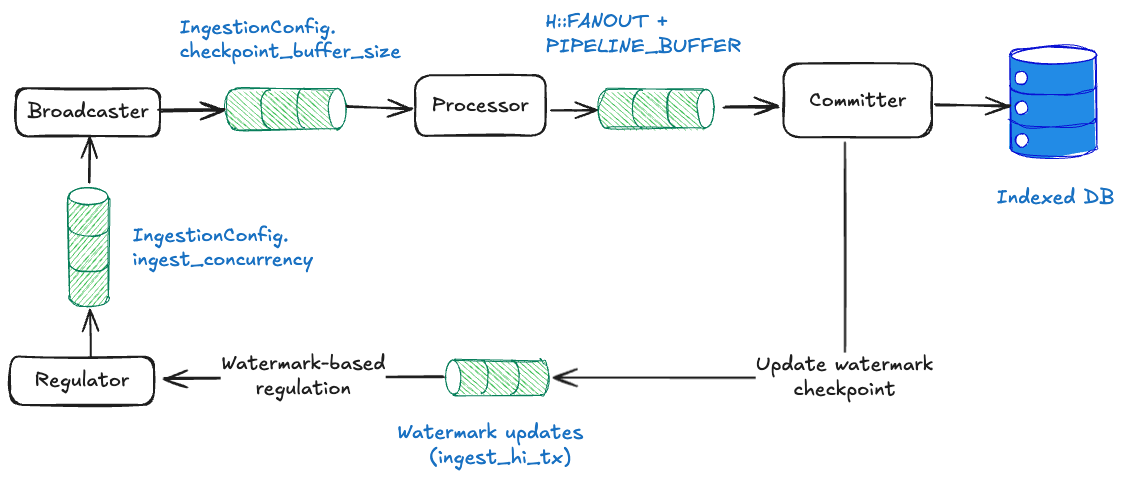
Channel-based backpressure
Sequential pipeline은 concurrent pipeline과 동일한 채널 기반 흐름 제어를 사용하지만(concurrent pipeline backpressure에서 자세한 메커니즘 참조), 컴포넌트 수가 적어 더 간단한 토폴로지를 가진다:
- Broadcaster → Processor:
checkpoint_buffer_size슬롯. - Processor → Committer:
FANOUT + PIPELINE_BUFFER슬롯.
Watermark-based regulation (sequential-specific)
Sequential pipeline은 체크포인트를 엄격한 순서로 처리해야 한다(N, 그 다음 N+1, 그 다음 N+2...). 체크포인트 N이 누락되면 사용 가능하더라도 이후 체크포인트를 커밋할 수 없다.
규제 없이 누락된 체크포인트는 다음과 같은 상황에서 데드락을 유발할 수 있다:
- 파이프라인이 체크포인트 100을 기다린다.
- 체크포인트 100이 삭제되거나 지연된다.
- 수집이 버퍼를 101, 102, 103...으로 채운다.
- 버퍼가 가득 차서 사용 가능할 때 체크포인트 100을 다시 가져올 수 없다.
- 파이프라인이 영구적으로 멈춘다.
이 함정을 피하기 위해 watermark 진행 보고를 사용할 수 있다. 성공적인 커밋 후 ingest_hi_tx 채널을 통해 파이프라인에 (pipeline_name, highest_committed_checkpoint)를 regulator에 보내도록 지시한다.
// Ignore the result -- the ingestion service will close this channel
// once it is done, but there may still be checkpoints buffered that need
// processing.
let _ = tx.send((H::NAME, watermark.checkpoint_hi_inclusive));
The Regulator receives updates by listening on ingest_hi_rx. It then calculates the ingestion boundary across all pipelines (min_subscriber_watermark + buffer_size). Regulator는 ingest_hi_rx에서 수신하여 업데이트를 받는다. 그런 다음 모든 파이프라인에 걸쳐 수집 경계를 계산한다(min_subscriber_watermark +buffer_size).
Some((name, hi)) = ingest_hi_rx.recv() => {
    subscribers_hi.insert(name, hi);
    ingest_hi = subscribers_hi.values().copied().min().map(|hi| hi + buffer_size as u64);
}
이 접근 방식은 다음과 같은 방법으로 데드락을 방지한다:
Regulator는 계산된 경계까지만 체크포인트를 가져온다.- 어떤 파이프라인도 수집 프론트에서 너무 뒤처지지 않는다.
- 누락된 체크포인트를 재시도하기 위한 버퍼 공간이 사용 가능하도록 보장한다.
Sequential pipeline만 이 유형의 규제가 필요하다. Concurrent pipeline은 체크포인트를 순서와 관계없이 처리할 수 있고 누락된 체크포인트는 전체 진행을 중단하는 것이 아니라 watermark 업데이트만 지연시킨다.
Performance tuning
Sequential pipeline은 더 기본적인 구성을 가지지만 중요한 튜닝 파라미터가 필요하다:
let config = SequentialConfig {
    committer: CommitterConfig {
        // Sequential pipeline에는 적용되지 않음
        write_concurrency: 1,

         // 배치 수집 빈도(ms 단위) (기본값: 500)
        collect_interval_ms: 1000,
    },

   // 라이브 데이터 대비 지연 체크포인트 수 (기본값: 0)
    checkpoint_lag: 100,
};
collect_interval_ms: 높은 값은 배치당 더 많은 체크포인트를 허용하여 효율성을 향상시킨다.checkpoint_lag: 불완전한 데이터 처리를 피하기 위해 라이브 인덱싱에 필수적이다.write_concurrency: Sequential pipeline에는 적용되지 않는다(항상 단일 스레드 쓰기).
Concurrent pipeline architecture
Concurrent pipeline 아키텍처를 살펴보기 전에 [previous section 에서 다룬 watermark 시스템을 이해해야 한다. Watermark 개념(checkpoint_hi_inclusive, reader_lo, pruner_hi, and retention)은 concurrent pipeline의 모든 컴포넌트가 작동하고 조정되는 방식의 기본이다.
Architecture overview
Concurrent pipeline은 데이터 무결성을 유지하면서 최대 처리량을 위해 설계된 정교한 다단계 아키텍처를 통해 원시 체크포인트 데이터를 인덱싱된 데이터베이스 레코드로 변환한다:
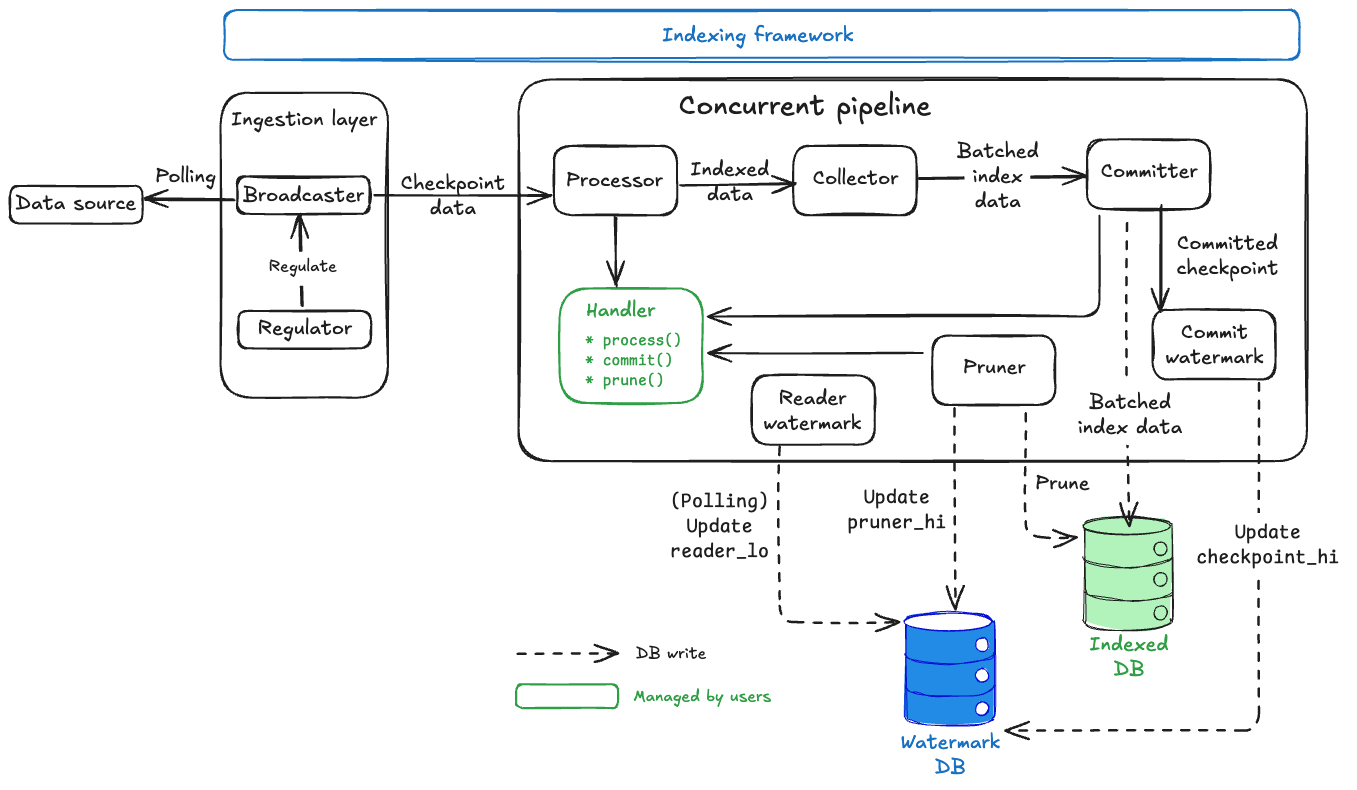
핵심 설계 원칙:
- Watermark coordination: 일관성 보장과 함께 안전한 순서와 관계없는 처리.
- Handler abstraction: 비즈니스 로직이 프레임워크에 연결되는 곳.
- Automatic storage management: 프레임워크가
Watermark데이터베이스 내에서 watermark 추적과 데이터 정리를 처리한다.
Concurrent pipeline components
Sequential pipeline에는 두 개의 주요 컴포넌트가 있다.
Processor
The Processor is the concurrent processing engine, handling multiple tasks running at the same time for maximum throughput. Its primary responsibility is to convert raw checkpoint data into database-ready rows using parallel workers.
The component handles this task by spawning FANOUT worker tasks (default: 10) for parallel processing. The FANOUT is the key configuration as it controls parallel processing capacity.
/// How much concurrency to use when processing checkpoint data.
const FANOUT: usize = 10;
Each worker calls your Handler::process() method independently.
let values = processor.process(&checkpoint)?;
Each of these workers can process different checkpoints simultaneously and in any order. The workers send their processed data to the Collector with checkpoint metadata.
Collector
Collector의 주요 책임은 처리된 데이터를 버퍼링하고 데이터베이스 쓰기를 위한 사용자 구성 가능한 배치를 만드는 것이다.
Collector는 여러 Processor 워커로부터 순서와 관계없이 처리된 데이터를 수신한다. 그런 다음 최적의 배치 크기(MIN_EAGER_ROWS)에 도달하거나 타임아웃이 충족될 때까지(조용한 파이프라인의 전진 진행을 보존하기 위해) 데이터를 버퍼링한다.
/// If at least this many rows are pending, the committer will commit them eagerly.
const MIN_EAGER_ROWS: usize = 50;
Collector는 여러 체크포인트의 데이터를 단일 데이터베이스 쓰기 배치로 결합하고 너무 많은 데이터가 대기 중일 때(MAX_PENDING_ROWS) 백프레셔를 적용한다.
/// If there are more than this many rows pending, the committer applies backpressure.
const MAX_PENDING_ROWS: usize = 5000;
데이터베이스 쓰기는 비용이 많이 든다. 배칭은 데이터베이스 왕복 횟수를 줄여 처리량을 극적으로 향상시킨다.
Committer
Committer는 주로 재시도 로직과 함께 병렬 연결을 사용하여 배칭된 데이터를 데이터베이스에 쓴다. 이를 위해 Collector로부터 최적화된 배치를 수신한 다음 병렬 데이터베이스 라이터를 write_concurrency까지 생성한다.
#[derive(Serialize, Deserialize, Debug, Clone)]
pub struct CommitterConfig {
    /// Number of concurrent writers per pipeline.
    pub write_concurrency: usize,

    /// The collector will check for pending data at least this often, in milliseconds.
    pub collect_interval_ms: u64,

    /// Watermark task will check for pending watermarks this often, in milliseconds.
    pub watermark_interval_ms: u64,
}
- 각 라이터는 지수 백오프 재시도와 함께
Handler::commit()메서드를 호출한다. - 성공적인 쓰기를
CommitterWatermark컴포넌트에 보고한다.
Committer 태스크는 실제로 데이터베이스 작업을 수행하지 않는다. 대신 핸들러의 commit() 메서드를 호출한다. 실제 데이터베이스 로직은 직접 구현해야 한다.
CommitterWatermark
CommitterWatermark의 주요 책임은 어떤 체크포인트가 완전히 커밋되었는지 추적하고 Watermark 테이블의 checkpoint_hi_inclusive를 업데이트하는 것이다.
CommitterWatermark는 성공적인 Committer 쓰기로부터 WatermarkParts를 수신한다.
/// A representation of the proportion of a watermark.
#[derive(Debug, Clone)]
struct WatermarkPart {
    /// The watermark itself
    watermark: CommitterWatermark,
    /// The number of rows from this watermark that are in this part
    batch_rows: usize,
    /// The total number of rows from this watermark
    total_rows: usize,
}
CommitterWatermark 는 체크포인트 완료 상태의 인메모리 맵을 유지하며 시퀀스에 갭이 없을 때만 checkpoint_hi_inclusive를 진행한다. 주기적으로 새로운 checkpoint_hi_inclusive를 Watermark 데이터베이스에 쓴다.
이 컴포넌트는 해당 지점까지의 모든 데이터가 갭 없이 커밋되었을 때만 checkpoint_hi_inclusive가 진행할 수 있다는 중요한 규칙을 적용한다. 이 컴포넌트가 그 중요한 규칙을 적용한다. 자세한 내용은 watermark system을 참조한다.
폴링을 사용하여 업데이트가 즉시가 아닌 구성 가능한 간격(watermark_interval_ms)으로 발생하여 일관성과 성능 사이의 균형을 맞춘다.
#[derive(Serialize, Deserialize, Debug, Clone)]
pub struct CommitterConfig {
    /// Number of concurrent writers per pipeline.
    pub write_concurrency: usize,

    /// The collector will check for pending data at least this often, in milliseconds.
    pub collect_interval_ms: u64,

    /// Watermark task will check for pending watermarks this often, in milliseconds.
    pub watermark_interval_ms: u64,
}
CommitterWatermark
ReaderWatermark의 주요 책임은 리텐션 정책을 유지하고 안전한 pruning 경계를 제공하기 위해 reader_lo를 계산하고 업데이트하는 것이다.
ReaderWatermark는 주기적으로(interval_ms) Watermark 데이터베이스를 폴링하여 현재 checkpoint_hi_inclusive를 확인한다. 그런 다음 새로운 reader_lo = checkpoint_hi_inclusive - retention + 1 값을 계산하고 Watermark 데이터베이스의 reader_lo와 pruner_timestamp를 업데이트한다. 이 동작은 조기 pruning을 방지하는 안전 버퍼를 제공한다.
reader_lo 값은 사용 가능이 보장되는 가장 낮은 체크포인트를 나타낸다. 이 컴포넌트는 리텐션 정책이 유지되도록 보장한다. 자세한 내용은 watermark system 섹션을 참조한다.
Pruner
Pruner 의 주요 책임은 리텐션 정책에 따라 오래된 데이터를 제거하고 pruner_hi를 업데이트하는 것이다.
Pruner는 reader_lo 업데이트 후 안전 지연(delay_ms)을 기다린다.
#[derive(Serialize, Deserialize, Debug, Clone)]
pub struct PrunerConfig {
    /// How often the pruner should check whether there is any data to prune, in milliseconds.
    pub interval_ms: u64,

    /// How long to wait after the reader low watermark was set, until it is safe to prune up until
    /// this new watermark, in milliseconds.
    pub delay_ms: u64,

    /// How much data to keep, this is measured in checkpoints.
    pub retention: u64,

    /// The maximum range to try and prune in one request, measured in checkpoints.
    pub max_chunk_size: u64,

    /// The max number of tasks to run in parallel for pruning.
    pub prune_concurrency: u64,
}
그런 다음 Pruner는 어떤 체크포인트를 안전하게 삭제할 수 있는지 계산하고 최대 prune_concurrency개의 병렬 정리 태스크를 생성한다.
#[derive(Serialize, Deserialize, Debug, Clone)]
pub struct PrunerConfig {
    /// How often the pruner should check whether there is any data to prune, in milliseconds.
    pub interval_ms: u64,

    /// How long to wait after the reader low watermark was set, until it is safe to prune up until
    /// this new watermark, in milliseconds.
    pub delay_ms: u64,

    /// How much data to keep, this is measured in checkpoints.
    pub retention: u64,

    /// The maximum range to try and prune in one request, measured in checkpoints.
    pub max_chunk_size: u64,

    /// The max number of tasks to run in parallel for pruning.
    pub prune_concurrency: u64,
}
각 태스크는 특정 체크포인트 범위에 대해 Handler::prune() 메서드를 호출하고 정리가 완료되면 pruner_hi를 업데이트한다.
Pruner 태스크는 실제로 데이터를 삭제하지 않는다. 대신 핸들러의 prune() 메서드를 호출한다. 실제 정리 로직은 직접 구현해야 한다.
Pruner는 현재 pruner_hi와 reader_lo에 의해 결정된 안전 경계 사이의 범위에서 작동하여 리더가 영향을 받지 않도록 보장한다. 자세한 내용은 watermark system을 참조한다.
Handler abstraction
Handler는 인덱싱 비즈니스 로직을 구현하는 곳이다. 프레임워크는 세 가지 핵심 메서드를 호출한다:
trait Processor {
    // Processor 워커에 의해 호출됨
    fn process(&self, checkpoint: &CheckpointData) -> Vec<Self::Value>;
}

trait Handler {
    // Committer 워커에 의해 호출됨
    async fn commit(&[Self::Value], &mut Connection) -> Result<usize>;

    // Pruner 워커에 의해 호출됨
    async fn prune(&self, from: u64, to: u64, &mut Connection) -> Result<usize>;
}
프레임워크 컴포넌트(Committer, Pruner)는 동시성, 재시도 및 watermark 조정을 관리하는 오케스트레이터이다. 실제 데이터베이스 작업은 Handler 메서드에서 발생한다.
Watermark table management
Watermark 테이블은 모든 watermark 조정을 관리한다. 프레임워크가 올바른 체크포인트에서 재개하기 위해 이 테이블을 읽으므로 복구에 중요하다.
인덱서를 처음 실행할 때 프레임워크가 자동으로 데이터베이스에 Watermark 테이블을 생성하고 관리한다. 테이블은 파이프라인당 하나의 행만 가질 수 있어 여러 인덱서가 동일한 데이터베이스를 공유할 수 있다.
Watermark 스키마:
// @generated automatically by Diesel CLI.

diesel::table! {
    watermarks (pipeline) {
        pipeline -> Text,
        epoch_hi_inclusive -> Int8,
        checkpoint_hi_inclusive -> Int8,
        tx_hi -> Int8,
        timestamp_ms_hi_inclusive -> Int8,
        reader_lo -> Int8,
        pruner_timestamp -> Timestamp,
        pruner_hi -> Int8,
    }
}
Concurrent pipeline backpressure mechanisms
컴포넌트 아키텍처를 자세히 살펴보았으므로 이제 파이프라인이 컴포넌트 간 채널을 사용하여 캐스케이딩 백프레셔를 통해 메모리 오버플로우를 방지하는 방법을 살펴본다.
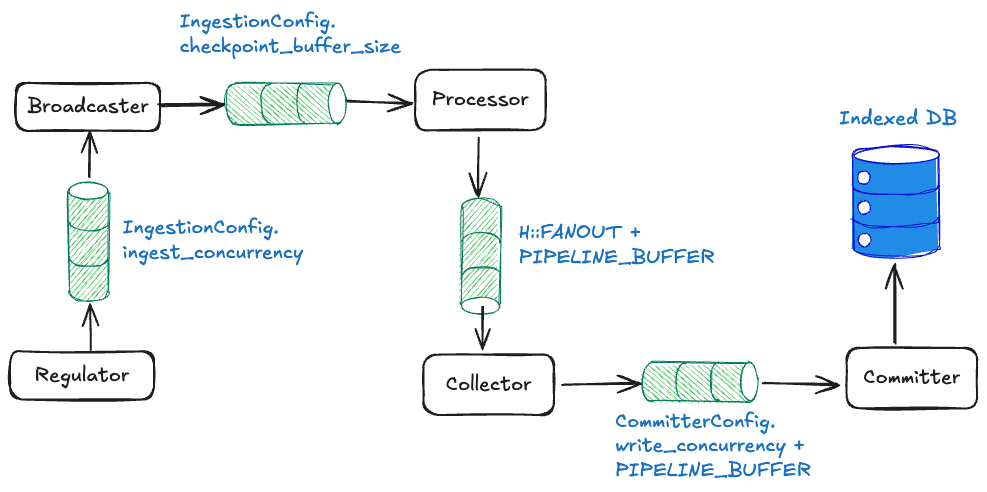
Channel-level blocking with fixed sizes
각 채널은 가득 차면 자동으로 차단되는 고정 버퍼 크기를 가진다:
Regulator to Broadcaster: ingest_concurrency 슬롯 → Regulator가 새 fetch 신호를 중단한다.
Struct not found. If code is formatted correctly, consider using code comments instead.
Broadcaster to Processor: checkpoint_buffer_size 슬롯 → Broadcaster가 차단되어 업스트림 압력이 발생한다.
#[derive(Serialize, Deserialize, Debug, Clone)]
pub struct IngestionConfig {
    /// Maximum size of checkpoint backlog across all workers downstream of the ingestion service.
    pub checkpoint_buffer_size: usize,

    /// Maximum number of checkpoints to attempt to fetch concurrently.
    pub ingest_concurrency: usize,

    /// Polling interval to retry fetching checkpoints that do not exist, in milliseconds.
    pub retry_interval_ms: u64,
}
Processor to Collector: FANOUT + PIPELINE_BUFFER 슬롯 → 모든 워커가 send()에서 차단된다.
Variable not found. If code is formatted correctly, consider using code comments instead.
Collector to Committer: write_concurrency + PIPELINE_BUFFER slots → Collector stops accepting. write_concurrency + PIPELINE_BUFFER슬롯 → Collector가 수락을 중단한다.
let (collector_tx, committer_rx) =
    mpsc::channel(committer_config.write_concurrency + PIPELINE_BUFFER);
어떤 채널이든 가득 차면 압력이 전체 파이프라인을 통해 자동으로 역방향으로 전파된다.
Component-level blocking
At the component level, the Collector respects memory limits and stops accepting when pending_rows ≥ MAX_PENDING_ROWS. 컴포넌트 수준에서 Collector는 메모리 제한을 준수하고 pending_rows ≥ MAX_PENDING_ROWS일 때 수락을 중단한다.
Some(indexed) = rx.recv(), if pending_rows < H::MAX_PENDING_ROWS => {
    metrics
        .total_collector_rows_received
        .with_label_values(&[H::NAME])
        .inc_by(indexed.len() as u64);
    metrics
        .total_collector_checkpoints_received
        .with_label_values(&[H::NAME])
        .inc();

    pending_rows += indexed.len();
    pending.insert(indexed.checkpoint(), indexed.into());

    if pending_rows >= H::MIN_EAGER_ROWS {
        poll.reset_immediately()
    }
}
데이터베이스 연결 제한도 있다. Committer는 모든 연결이 사용 중일 때 차단된다.
Application-level coordination
Watermark 피드백은 Watermark 업데이트를 통해 Regulator에 진행 상황을 보고하여 애플리케이션 수준 조정을 제공한다. 추가 조정은 제한된 수집을 통해 제공되며, Regulator는 현재 watermark보다 제한된 범위 내에서만 페치를 신호한다.
res = checkpoint_tx.send(*cp), if ingest_hi.is_none_or(|hi| *cp <= hi) => if res.is_ok() {
    checkpoints.next();
} else {
    info!("Checkpoint channel closed, stopping regulator");
    break;
}
마지막으로 메모리 보호는 전체 시스템이 예측 가능한 메모리 범위 내에서 작동하도록 보장한다.
Backpressure in practice
기본 예제: 느린 데이터베이스 시나리오
- Initial state: 인덱서가 초당 100개의 체크포인트를 처리하고 있다.
- Bottleneck appears: 데이터베이스가 느려져서(높은 부하, 유지보수 또는 유사한 이유) 이제 초당 50개의 커밋만 처리할 수 있다.
- Backpressure cascade:
Committer채널이 가득 찬다(충분히 빠르게 커밋할 수 없다).Collector가Committer로 보내기를 중단한다(채널 가득 참).Processor워커가Collector로 보내기를 중단한다(채널 가득 참).Broadcaster가Processors로 보내기를 중단한다(채널 가득 참).Regulator가 새 체크포인트 요청을 중단한다(채널 가득 참).
- End result:
- 인덱서가 자동으로 데이터베이스 용량에 맞춰 초당 50개의 체크포인트로 느려진다.
- 메모리가 제한되어 있어 과도한 증가가 없다.
- 모든 것이 더 느리게 처리되므로 데이터 손실이 없다.
- 시스템이 병목 지점의 속도로 안정적이다.
- Recovery: 데이터베이스가 빨라지면 채널이 비워지기 시작하고 인덱서가 자동으로 전속력으로 돌아온다.
발생하는 현상:
- 로그와 메트릭에서 체크포인트 진행이 느려진다.
- 안정적인 메모리 사용량(증가 없음).
- 시스템이 반응성을 유지하지만 처리량이 감소한다.
Performance tuning
다음 섹션에서는 최적의 성능을 위해 구현할 수 있는 구성 설정을 자세히 설명한다.
Concurrent pipeline Handler constants
Handler 상수는 파이프라인 동작을 튜닝하는 가장 직접적인 방법이다. 이들은 Handler trait 구현에서 연관 상수로 구현된다.
impl concurrent::Handler for MyHandler {
    type Store = Db;

    // 동시 processor 워커 수 (기본값: 10)
    const FANOUT: usize = 20;

    // Committer의 eager 커밋을 트리거하는 최소 행 수 (기본값: 50)
    const MIN_EAGER_ROWS: usize = 100;

    // Committer의 백프레셔 임계값 (기본값: 5000)
    const MAX_PENDING_ROWS: usize = 10000;

    // 배치당 최대 watermark 수 (기본값: 10,000)
    const MAX_WATERMARK_UPDATES: usize = 5000;
}
튜닝 가이드라인:
FANOUT: CPU 집약적인 처리의 경우 증가시키고 메모리가 제한된 환경에서는 감소시킨다.MIN_EAGER_ROWS: 낮은 값은 데이터 커밋 지연 시간을 줄이고(개별 데이터가 데이터베이스에 더 빨리 나타남), 높은 값은 전체 처리량을 향상시킨다(더 효율적인 큰 배치).MAX_PENDING_ROWS: Committer가 뒤처질 때 얼마나 많은 데이터가 축적될 수 있는지 제어한다. 높은 값은 더 많은 버퍼 공간을 제공하지만 병목 지점에서 더 많은 메모리를 사용한다.MAX_WATERMARK_UPDATES: 희소한 파이프라인(드문 이벤트)의 경우 낮추고 밀집된 파이프라인의 경우 기본값을 유지한다.
CommitterConfig optimization
CommitterConfig는 데이터가 수집에서 데이터베이스 커밋으로 흐르는 방식을 제어한다:
let config = ConcurrentConfig {
    committer: CommitterConfig {
        // 병렬 데이터베이스 라이터 수 (기본값: 5)
        write_concurrency: 10,

        // Collector가 배치를 확인하는 빈도(ms 단위) (기본값: 500)
        collect_interval_ms: 250,

        // Watermark가 업데이트되는 빈도(ms 단위) (기본값: 500)
        watermark_interval_ms: 1000,
    },
    pruner: Some(pruner_config),
};
튜닝 가이드라인:
write_concurrency: 높은 값은 더 빠른 처리량을 제공하지만 더 많은 데이터베이스 연결을 사용한다.ensure total_pipelines × write_concurrency < db_connection_pool_size를 확인한다.collect_interval_ms: 낮은 값은 지연 시간을 줄이지만 CPU 오버헤드를 증가시킨다.watermark_interval_ms: Watermark가 얼마나 자주 업데이트되는지 제어한다. 높은 값은 빈번한 watermark 쓰기로 인한 데이터베이스 경합을 줄이지만 인덱서가 파이프라인 진행에 더 느리게 응답하게 만든다.
PrunerConfig settings
데이터 리텐션과 pruning 성능을 구성한다:
let pruner_config = PrunerConfig {
    // Pruning 기회 확인 간격(ms 단위) (기본값: 300,000 = 5분)
    interval_ms: 600_000, // 덜 빈번한 확인을 위해 10분

    // Reader watermark 업데이트 후 안전 지연(ms 단위) (기본값: 120,000 = 2분)
    delay_ms: 300_000,// 보수적인 pruning을 위해 5분

    // 유지할 체크포인트 수 (기본값: 4,000,000)
    retention: 10_000_000,  // 분석을 위해 더 많은 데이터 유지

    // 작업당 최대 pruning 체크포인트 수 (기본값: 2,000)
    max_chunk_size: 5_000, // 더 빠른 pruning을 위해 큰 청크

    // 병렬 pruning 태스크 수 (기본값: 1)
    prune_concurrency: 3, // 더 빠른 pruning을 위해 더 많은 병렬 처리
};
튜닝 가이드라인:
retention: 스토리지 비용과 데이터 가용성 요구 사이의 균형을 맞춘다.max_chunk_size: 큰 값은 더 빠른 pruning을 제공하지만 더 긴 데이터베이스 transaction을 유발한다.prune_concurrency: 데이터베이스 연결 제한을 초과하지 않도록 한다.delay_ms: 안전을 위해 증가시키고 적극적인 스토리지 최적화를 위해 감소시킨다.
Related links
The sui-indexer-alt-framework is a powerful Rust framework for building high-performance, custom blockchain indexers on Sui. It provides customizable, production-ready components for data ingestion, processing, and storage.
The life of a transaction on the Sui network has some differences compared to those from other blockchains.
Establishing a custom indexer helps improve latency, allows pruning the data of your Sui full node, and provides efficient assemblage of checkpoint data.