인덱서 파이프라인 아키텍처
sui-indexer-alt-framework는 두 가지 고유한 파이프라인 아키텍처를 제공한다. 올바른 접근 방식을 선택하려면 이 차이점을 이해하는 것이 중요하다.
Sequential pipeline과 concurrent pipeline 비교
Sequential pipelines은 complete checkpoints를 순서대로 commit한다. 각 checkpoint는 다음 checkpoint보다 먼저 완전히 commit되므로 단순하고 일관된 reads를 보장한다.
Concurrent pipelines은 순서와 무관하게 commit하며 개별 checkpoints를 부분적으로 commit할 수 있다. 이를 통해 더 높은 throughput을 위해 여러 checkpoints를 동시에 처리할 수 있지만, 일관성을 보장하려면 reads가 어떤 데이터가 완전히 commit되었는지 확인해야 한다.
각 pipeline 사용 시점
두 파이프라인 유형 모두 in-place updates, aggregations, complex business logic를 처리할 수 있다. Sequential pipelines는 concurrent pipelines에 비해 throughput 제한이 있지만, 둘 중 하나를 선택하는 결정은 성능 요구 사항보다 엔지니어링 복잡성에 더 가깝다.
권장: Sequential pipeline
대부분의 사용 사례에서는 여기서 시작한다. 더 직접적인 구현과 유지보수를 제공한다.
- ✓ 직접적인 commits와 단순한 queries를 갖는 직관적인 구현을 원한다.
- ✓ 팀이 예측 가능하고 디버깅하기 쉬운 동작을 선호한다.
- ✓ 현재 성능이 요구 사항을 충족한다.
- ✓ 운영 단순성을 중요하게 여긴다.
Concurrent pipeline 방식
다음과 같은 경우에는 concurrent pipeline 구현을 고려한다:
- ✓ 성능 최적화가 필수적이다.
- ✓ sequential processing이 데이터 볼륨을 따라갈 수 없다.
- ✓ 팀이 성능 이점을 위해 추가적인 구현 복잡성을 감수할 의향이 있다.
순서와 무관한 commits를 지원하면 파이프라인에 몇 가지 추가 복잡성이 생긴다:
- Watermark-aware queries: 모든 reads는 어떤 데이터가 완전히 commit되었는지 확인해야 한다. 자세한 내용은 the watermark system 섹션을 참조한다.
- Complex application logic: complete checkpoints를 처리하는 대신 data commits를 조각 단위로 처리해야 한다.
결정 framework
프로젝트에 어떤 파이프라인을 선택해야 할지 확신이 없다면 구현과 디버깅이 더 쉬운 sequential pipeline으로 시작한다. 그런 다음 현실적인 부하에서 성능을 측정한다. Sequential pipeline이 프로젝트 요구 사항을 충족할 수 없다면 concurrent pipeline으로 전환한다.
전체 목록은 아니지만 sequential pipeline이 요구 사항을 충족하지 못할 수 있는 구체적인 시나리오에는 다음이 포함된다:
- 파이프라인이 각 checkpoint에서 chunking과 out-of-order commits의 이점을 얻는 데이터를 생성한다. 개별 checkpoints는 많은 데이터나 latency를 유발할 수 있는 개별 writes를 생성할 수 있다.
- pruning이 필요한 많은 데이터를 생성하고 있다. 이 경우 concurrent pipeline을 사용해야 한다.
어떤 파이프라인을 사용할지 결정하는 것 외에도 scaling도 고려해야 한다. 여러 종류의 데이터를 indexing한다면 여러 pipelines와 watermarks를 사용하는 것을 고려한다.
공통 pipeline component
Sequential pipelines와 concurrent pipelines는 공통된 components와 concepts를 공유한다. 이러한 공통 요소를 이해하면 두 아키텍처가 어떻게 다른지 더 명확해진다.
Processor component 설명
The Processor is the concurrent processing engine, handling multiple tasks running at the same time for maximum throughput. Its primary responsibility is to convert raw checkpoint data into database-ready rows using parallel workers.
The component handles this task by spawning FANOUT worker tasks (default: 10) for parallel processing. The FANOUT is the key configuration as it controls parallel processing capacity.
Variable not found. If code is formatted correctly, consider using code comments instead.
Each worker calls your Handler::process() method independently.
Variable not found. If code is formatted correctly, consider using code comments instead.
Each of these workers can process different checkpoints simultaneously and in any order. The workers send their processed data to the Collector with checkpoint metadata.
Processor component는 sequential pipelines와 concurrent pipelines에서 동일하게 동작한다. 이는 Broadcaster로부터 checkpoint data를 받아 custom logic으로 변환하고, 처리된 결과를 파이프라인의 다음 단계로 전달한다.
Watermark concept 요약
파이프라인별 아키텍처를 살펴보기 전에 coordination에 사용되는 세 가지 watermarks를 이해한다:
| Watermark | Purpose | Used by |
|---|---|---|
checkpoint_hi_inclusive | 갭 없이 모든 data가 commit된 가장 높은 checkpoint | 복구와 진행 상황 추적을 위한 양쪽 pipelines |
reader_lo | queries에 사용할 수 있음이 보장되는 가장 낮은 checkpoint | pruning이 활성화된 concurrent pipelines |
pruner_hi | pruning된(deleted) 가장 높은 checkpoint | pruning이 활성화된 concurrent pipelines |
이 watermarks들은 함께 안전한 out-of-order processing, 자동 data cleanup, failures로부터의 recovery를 가능하게 한다.
Watermark system 개요
각 pipeline에 대해 indexer는 최소한 해당 지점까지의 모든 data가 commit된 가장 높은 checkpoint를 추적한다. 추적은 committer watermark인 checkpoint_hi_inclusive를 통해 수행된다. Concurrent pipelines와 sequential pipelines 모두 restart 시 처리를 재개할 위치를 이해하기 위해 checkpoint_hi_inclusive에 의존한다.
선택적으로 pipeline은 pruning이 활성화된 경우 읽기와 pruning 작업의 안전한 하한을 정의하는 reader_lo와 pruner_hi를 추적한다. 이러한 watermarks는 data integrity를 유지하면서 out-of-order processing을 가능하게 하므로 concurrent pipelines에 특히 중요하다.
안전한 pruning
Watermark system은 강력한 data lifecycle management system을 만든다:
- Guaranteed data availability: checkpoint data availability rules를 적용하여 readers가 안전한 queries를 수행하도록 보장한다.
- Automatic cleanup process: pipeline은 retention 보장을 유지하면서 storage가 무한히 증가하지 않도록 unpruned checkpoints를 자주 정리한다. Pruning process는 race conditions를 피하기 위해 safety delay와 함께 실행된다.
- Balanced approach: system은 안전성과 효율성 사이의 균형을 맞춘다.
- Storage efficiency: 오래된 데이터는 자동으로 삭제된다.
- Data availability: 항상 retention 양만큼의 complete data를 유지한다.
- Safety guarantees: readers는 누락된 data gaps를 만나지 않는다.
- Performance: out-of-order processing이 throughput을 극대화한다.
이 watermark system은 concurrent pipelines를 고성능이면서도 신뢰할 수 있게 만들어 주며, 강력한 data availability guarantees와 자동 storage management를 유지하면서 대규모 throughput을 가능하게 한다.
Scenario 1: 기본 watermark(pruning 없음)
Pruning이 비활성화된 경우 indexer는 각 pipeline committer의 checkpoint_hi_inclusive만 보고한다. 다음 타임라인을 생각해 보자. 여기서는 여러 checkpoints가 처리되고 있으며 일부는 순서와 무관하게 commit된다.
Checkpoint Processing Timeline:

[1000] [1001] [1002] [1003] [1004] [1005]
  ✓      ✓      ✗      ✓      ✗      ✗
         ^
  checkpoint_hi_inclusive = 1001

✓ = Committed (all data written)
✗ = Not Committed (processing or failed)
이 시나리오에서 checkpoint 1003이 commit되었더라도 1002에 여전히 gap이 있기 때문에 checkpoint_hi_inclusive는 1001이다. Indexer는 start부터 checkpoint_hi_inclusive까지의 모든 data를 사용할 수 있다는 보장을 만족하기 위해 high watermark를 1001로 보고해야 한다.
Checkpoint 1002가 commit된 후에는 1003까지의 데이터를 안전하게 읽을 수 있다.
[1000] [1001] [1002] [1003] [1004] [1005]
  ✓      ✓      ✓      ✓      ✗       ✗
[---- SAFE TO READ -------]
(start   →   checkpoint_hi_inclusive at 1003)
Scenario 2: pruning 활성화
Pruning은 retention policy로 구성된 pipelines에 대해 활성화된다. 예를 들어 table이 너무 커져 마지막 4개의 checkpoints만 유지하려면 retention = 4이다. 이는 indexer가 checkpoint_hi_inclusive와 구성된 retention의 차이로 reader_lo를 주기적으로 업데이트한다는 뜻이다. 별도의 pruning task는 [pruner_hi, reader_lo] 사이의 data를 pruning하는 역할을 한다.
[998] [999] [1000] [1001] [1002] [1003] [1004] [1005] [1006]
 🗑️    🗑️     ✓      ✓      ✓      ✓      ✗      ✗      ✗
              ^                    ^
       reader_lo = 1000       checkpoint_hi_inclusive = 1003

🗑️ = Pruned (deleted)
✓ = Committed
✗ = Not Committed
Current watermarks:
-
checkpoint_hi_inclusive= 1003:- start부터 1003까지의 모든 data가 complete하다(gaps 없음).
- 1004가 아직 commit되지 않았기 때문에(gap) 1005로 advance할 수 없다.
-
reader_lo= 1000:- availability가 보장되는 가장 낮은 checkpoint이다.
- 다음과 같이 계산된다:
reader_lo = checkpoint_hi_inclusive - retention + 1. reader_lo= 1003 - 4 + 1 = 1000.
-
pruner_hi= 1000:- 삭제된 가장 높은 exclusive checkpoint이다.
- checkpoints 998과 999는 공간 절약을 위해 삭제되었다.
Clear safe zones:
[998] [999] [1000] [1001] [1002] [1003] [1004] [1005] [1006]
 🗑️    🗑️     ✓      ✓      ✓      ✓      ✗      ✗      ✓

[--PRUNED--][--- Safe Reading Zone ---] [--- Processing ---]
Watermark가 시간에 따라 진행되는 방식
Step 1: Checkpoint 1004가 완료된다.
[999] [1000] [1001] [1002] [1003] [1004] [1005] [1006] [1007]
 🗑️     ✓      ✓      ✓      ✓      ✓      ✗      ✓      ✗
        ^                           ^
 reader_lo = 1000           checkpoint_hi_inclusive = 1004 (advanced by 1)
 pruner_hi = 1000
이제 checkpoint 1004가 commit되었으므로 1004까지 gaps가 없어서 checkpoint_hi_inclusive는 1003에서 1004로 advance할 수 있다. reader_lo와 pruner_hi는 아직 바뀌지 않았다는 점에 유의한다.
Step 2: Reader watermark가 주기적으로 업데이트된다.
[999] [1000] [1001] [1002] [1003] [1004] [1005] [1006] [1007]
 🗑️     ✓      ✓      ✓      ✓      ✓      ✗      ✓      ✗
               ^                   ^
        reader_lo = 1001    checkpoint_hi_inclusive = 1004
        (1004 - 4 + 1 = 1001)

pruner_hi = 1000 (unchanged as pruner hasn't run yet)
별도의 reader watermark update task가 주기적으로 실행되며(구성 가능), retention policy에 따라 reader_lo를 1001로 advance한다(1004 - 4 + 1 = 1001로 계산). 그러나 pruner는 아직 실행되지 않았으므로 pruner_hi는 1000으로 유지된다.
Step 3: Pruner가 safety delay 이후 실행된다.
[999] [1000] [1001] [1002] [1003] [1004] [1005] [1006] [1007]
 🗑️     🗑️     ✓      ✓      ✓      ✓      ✗      ✓      ✗
               ^                   ^
        reader_lo = 1001    checkpoint_hi_inclusive = 1004
        pruner_hi = 1001
pruner_hi (1000) < reader_lo (1001)이므로 pruner는 일부 checkpoints가 retention window 밖에 있음을 감지한다. 이는 reader_lo까지의 모든 요소를 정리하고(checkpoint 1000 삭제) pruner_hi를 reader_lo(1001)로 업데이트한다.
reader_lo보다 오래된 checkpoints도 다음 이유 때문에 일시적으로는 여전히 사용 가능할 수 있다:
- in-flight queries를 보호하기 위한 의도적인 delay
- pruner가 cleanup을 아직 완료하지 않음
Sequential pipeline architecture 구조
Sequential pipelines는 ordered processing을 우선시하는 보다 직접적이면서도 강력한 indexing 아키텍처를 제공한다. Concurrent pipelines에 비해 일부 throughput을 희생하지만 더 강한 guarantees를 제공하며, 대체로 reasoning하기 더 쉽다.
Architecture 개요
Sequential pipeline은 두 개의 주요 components만으로 구성되어 concurrent pipeline의 여섯 component 아키텍처보다 훨씬 단순하다.
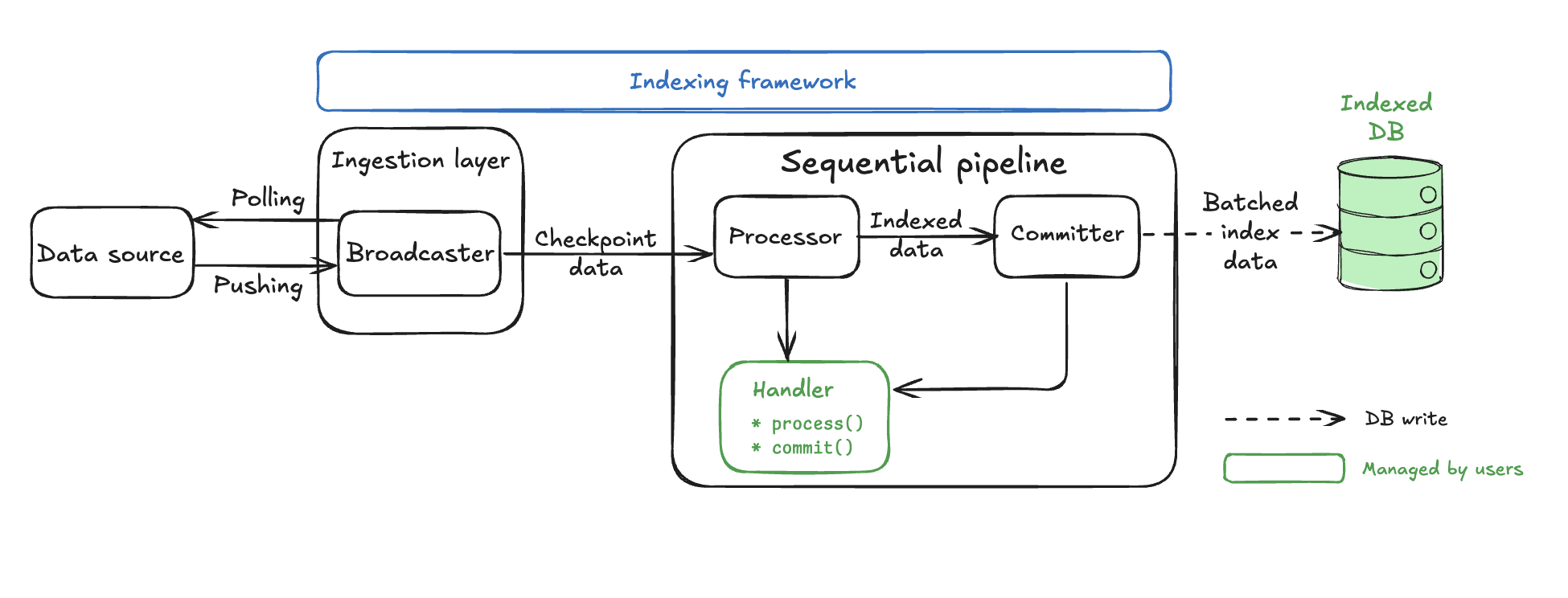
Broadcaster와 Processor components는 concurrent pipeline과 동일한 backpressure mechanisms, adaptive parallel processing, processor() implementations를 사용한다. Processor component는 Common pipeline components 섹션에서 자세히 설명한다.
핵심 차이점은 ordering, batching, database commits를 처리하는 단 하나의 Committer component만 있는 극적으로 단순화된 pipeline core이다. 반대로 concurrent pipelines는 Processor 외에 Collector, Committer, CommitterWatermark, ReaderWatermark, Pruner라는 다섯 개의 별도 components를 가진다.
Sequential pipeline component 구성
Sequential pipelines는 shared Processor 외에 pipeline-specific component 하나, 즉 Committer를 가진다.
Committer
Sequential Committer는 pipeline의 주요 component이자 주된 customization 지점이다. 높은 수준에서 Committer는 다음 작업을 수행한다:
- Receives processor로부터 순서와 무관하게 처리된 data를 받는다.
- Orders data를 checkpoint sequence 기준으로 정렬한다.
- Batches 여러 checkpoints를 사용자의 logic으로 함께 batching한다.
- Commits batch를 데이터베이스에 원자적으로 commit한다.
이를 customize하기 위해 사용자의 코드는 committer가 호출하는 두 개의 핵심 함수를 사용한다:
batch(): data merging logic.
fn batch(&self, batch: &mut Self::Batch, values: std::vec::IntoIter<Self::Value>);
commit(): database write logic.
async fn commit<'a>(
    &self,
    batch: &Self::Batch,
    conn: &mut <Self::Store as Store>::Connection<'a>,
) -> anyhow::Result<usize>;
Sequential pipeline backpressure 메커니즘
Sequential pipelines는 memory overflow와 ordering-related deadlocks를 방지하기 위해 두 계층의 backpressure를 사용한다:
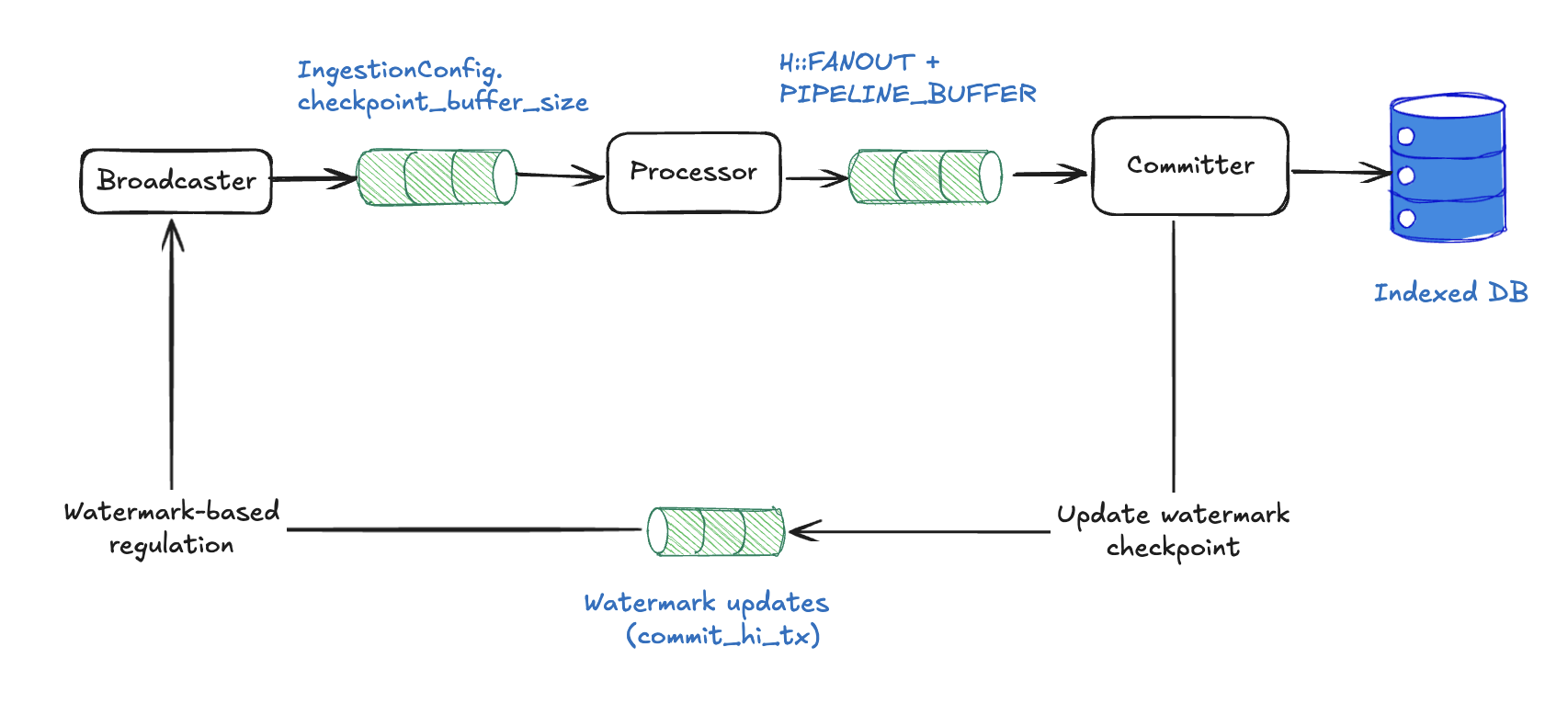
Channel 기반 backpressure
Sequential pipelines는 concurrent pipelines와 동일한 bounded-channel backpressure model을 사용한다:
- Broadcaster → Processor:
subscriber_channel_sizeslots를 가진 bounded channel. 가득 차면 send가 block되며, broadcaster의 adaptive controller는 channel의len / capacity를 읽고 subscriber가 뒤처질 때ingest_concurrency를 줄인다. - Processor → Committer:
processor_channel_sizeslots (num_cpus / 2가 기본값). Processor의 adaptivefanoutcontroller를 구동한다.
Downstream pressure는 역방향으로 전파된다. Committer가 느려지면 processor-to-committer channel이 차고 fanout이 minimum으로 줄어든다. 그다음 broadcaster-to-processor channel이 차며 broadcaster가 ingest_concurrency를 줄인다. Committer 자체는 pending checkpoints의 unbounded in-memory buffer를 보유하므로, 순서와 무관하게 도착한 checkpoints도 contiguous prefix를 구성해 commit할 수 있다.
Performance tuning 조정
Sequential pipelines는 더 기본적인 구성을 갖지만 여전히 중요한 tuning parameters가 필요하다:
use sui_indexer_alt_framework::config::ConcurrencyConfig;

let config = SequentialConfig {
    committer: CommitterConfig {
        // Not applicable to sequential pipelines
        write_concurrency: 1,

        // Batch collection frequency in ms (default: 500)
        collect_interval_ms: 1000,
    },

    // Adaptive concurrency (default). Starts at 1 and scales up to num_cpus.
    fanout: None,
    // Or use fixed concurrency:
    // fanout: Some(ConcurrencyConfig::Fixed { value: 20 }),
    // Or customize adaptive bounds:
    // fanout: Some(ConcurrencyConfig::Adaptive {
    //     initial: 5,
    //     min: 1,
    //     max: 32,
    // }),

    min_eager_rows: None,
    max_batch_checkpoints: None,
    processor_channel_size: None, // defaults to num_cpus / 2

    // Per-pipeline overrides for the ingestion layer's defaults.
    ingestion: pipeline::IngestionConfig {
        // None falls back to the built-in default (max(num_cpus / 2, 4)).
        subscriber_channel_size: None,
    },
};
collect_interval_ms: 값이 높을수록 batch당 더 많은 checkpoints를 허용하므로 효율성이 좋아진다.write_concurrency: sequential pipelines에는 적용되지 않는다(항상 single-threaded writes이다).fanout: 기본적으로 processor concurrency는 adaptive이며, 1에서 시작해 downstream channel pressure에 따라 CPU 개수까지 확장된다. Controller는 processor-to-committer channel의 fill fraction을 모니터링하고 60%와 85% fill 사이의 dead band를 사용해 concurrency를 조정한다. 이는 fixed concurrency(ConcurrencyConfig::Fixed)로 override할 수도 있고 adaptive bounds(ConcurrencyConfig::Adaptive)를 customize할 수도 있다. 기본 max인num_cpus는 processor가 CPU-bound라고 가정한다. Processor가 IO를 수행한다면(예를 들어 외부 서비스에서 데이터를 가져오는 경우) 더 높은 max를 원할 수 있다. Adaptive controller는 fill-fraction thresholds를 override하는dead_bandparameter도 제공하지만, 기본값이면 대부분의 workloads에 충분하다.ingestion.subscriber_channel_size: bounded broadcaster-to-processor channel의 capacity이다.None이면 기본값max(num_cpus / 2, 4)를 사용한다. 가끔 burst가 있는 pipeline은 자체 capacity를 늘릴 수 있지만, 값이 클수록 해당 pipeline이 shared controller에 덜 찬 것처럼 보이므로 throttling이 다른 pipeline보다 늦게 trigger된다.processor_channel_size: processor와 committer 사이 channel의 크기를 제어한다. 기본값은num_cpus / 2이다. 이 channel은 adaptive concurrency controller를 구동하는 signal이기도 하다.
Concurrent pipeline architecture 구조
Concurrent pipelines는 raw checkpoint data를 indexed database records로 변환하는 정교한 multi-stage architecture를 제공하며, data integrity를 유지하면서 최대 throughput을 달성하도록 설계되었다. watermark system section에서 다룬 watermark system은 모든 component가 coordination하는 방식의 기반이다.
Architecture 개요
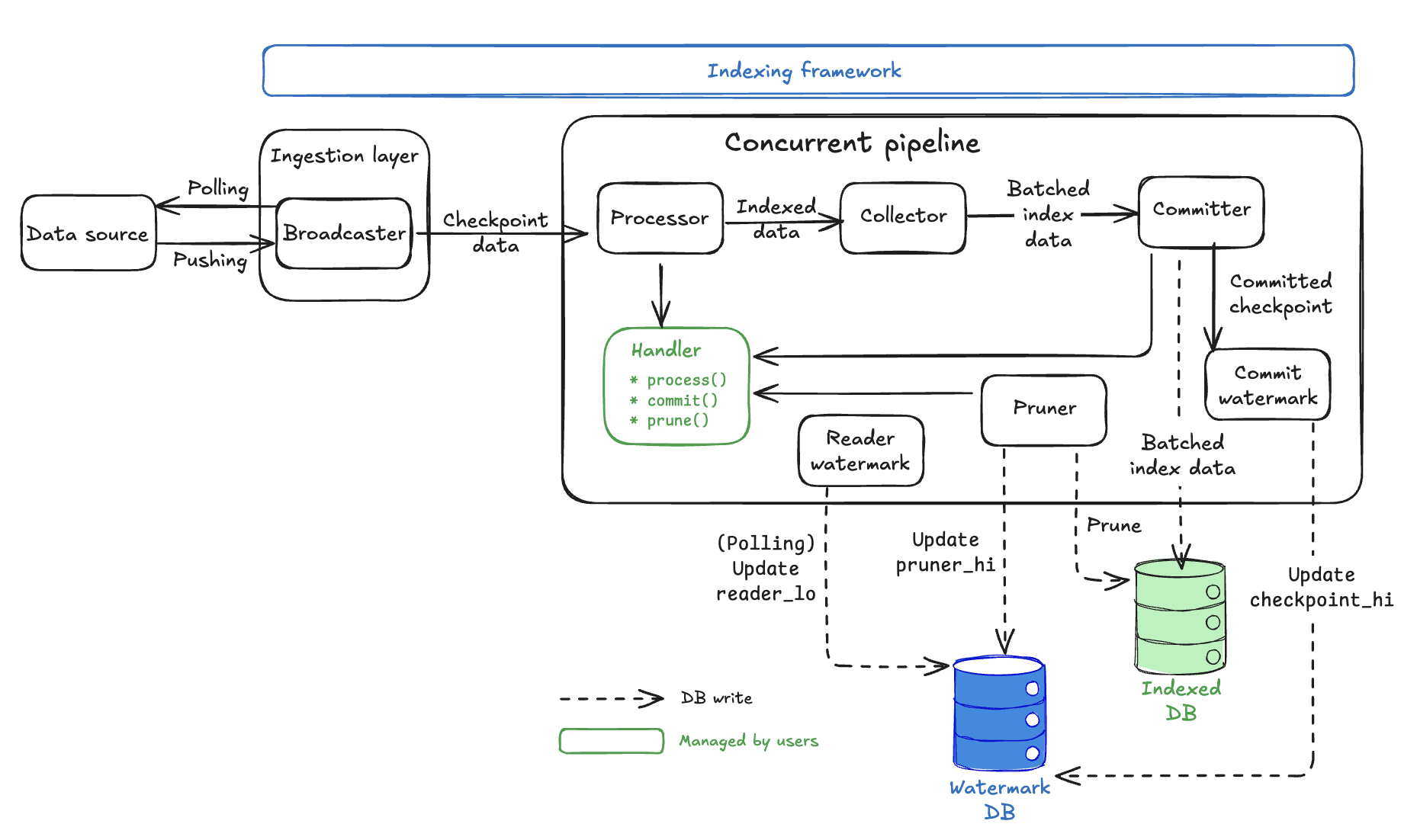
Key design principles:
- Watermark coordination: 일관성 보장과 함께 안전한 out-of-order processing을 가능하게 한다.
- Handler abstraction: business logic가 framework에 연결되는 지점이다.
- Automatic storage management: framework가
Watermarkdatabase 안에서 watermark tracking과 data cleanup을 처리한다.
Concurrent pipeline component 구성
Concurrent pipelines는 shared Processor 외에 다섯 개의 pipeline-specific components를 가진다:
Collector
Collector의 주요 책임은 처리된 data를 buffer하고 database writes를 위한 user-configurable batches를 만드는 것이다.
Collector는 여러 Processor workers로부터 out-of-order로 처리된 data를 받는다. 그런 다음 최적의 batch size(MIN_EAGER_ROWS)에 도달하거나 timeout이 만족될 때까지 data를 buffer한다(조용한 pipelines에서도 forward progress를 보존하기 위함이다).
/// If at least this many rows are pending, the committer will commit them eagerly.
const MIN_EAGER_ROWS: usize = 50;
Collector는 여러 checkpoints의 data를 하나의 database write batch로 결합하고, pending data가 너무 많을 때(MAX_PENDING_ROWS) backpressure를 적용한다.
/// If there are more than this many rows pending, the committer applies backpressure.
const MAX_PENDING_ROWS: usize = 5000;
Database writes는 비용이 크므로 batching은 database round trips 수를 줄여 throughput을 크게 향상시킨다.
Committer
Committer는 주로 retry logic이 있는 parallel connections를 사용해 batched data를 database에 쓴다. 이를 위해 Collector로부터 최적화된 batches를 받아 write_concurrency까지 parallel database writers를 생성한다.
#[derive(Serialize, Deserialize, Debug, Clone)]
pub struct CommitterConfig {
    /// Number of concurrent writers per pipeline.
    pub write_concurrency: usize,

    /// The collector will check for pending data at least this often, in milliseconds.
    pub collect_interval_ms: u64,

    /// Watermark task will check for pending watermarks this often, in milliseconds.
    pub watermark_interval_ms: u64,

    /// Maximum random jitter to add to the watermark interval, in milliseconds.
    pub watermark_interval_jitter_ms: u64,
}
- 각 writer는 exponential backoff retry와 함께 사용자의
Handler::commit()method를 호출한다. - Successful writes를
CommitterWatermarkcomponent에 보고한다.
Committer tasks는 실제 database operations를 수행하지 않는다. 대신 handler의 commit() method를 호출한다. 실제 database logic은 직접 구현해야 한다.
CommitterWatermark
CommitterWatermark의 주요 책임은 어떤 checkpoints가 완전히 commit되었는지 추적하고 Watermark table의 checkpoint_hi_inclusive를 업데이트하는 것이다.
CommitterWatermark는 성공적인 Committer writes로부터 WatermarkParts를 받는다.
/// A representation of the proportion of a watermark.
#[derive(Debug, Clone)]
struct WatermarkPart {
    /// The watermark itself
    watermark: CommitterWatermark,
    /// The number of rows from this watermark that are in this part
    batch_rows: usize,
    /// The total number of rows from this watermark
    total_rows: usize,
}
CommitterWatermark는 checkpoint completion status의 in-memory map을 유지하며, sequence에 gaps가 없을 때만 checkpoint_hi_inclusive를 advance한다. 주기적으로 새로운 checkpoint_hi_inclusive를 Watermark database에 쓴다.
이 component는 해당 지점까지의 모든 data가 gaps 없이 commit되었을 때만 checkpoint_hi_inclusive가 advance할 수 있다는 중요한 규칙을 강제한다. 이것이 safe out-of-order processing을 가능하게 하는 방식에 대한 자세한 내용은 watermark system을 참조한다.
Polling을 사용하므로 updates는 즉시 일어나는 대신 구성 가능한 interval(watermark_interval_ms)에 따라 발생하며, 일관성과 성능 사이의 균형을 맞춘다.
#[derive(Serialize, Deserialize, Debug, Clone)]
pub struct CommitterConfig {
    /// Number of concurrent writers per pipeline.
    pub write_concurrency: usize,

    /// The collector will check for pending data at least this often, in milliseconds.
    pub collect_interval_ms: u64,

    /// Watermark task will check for pending watermarks this often, in milliseconds.
    pub watermark_interval_ms: u64,

    /// Maximum random jitter to add to the watermark interval, in milliseconds.
    pub watermark_interval_jitter_ms: u64,
}
ReaderWatermark
ReaderWatermark의 주요 책임은 retention policy를 유지하고 safe pruning boundaries를 제공하기 위해 reader_lo를 계산하고 업데이트하는 것이다.
ReaderWatermark는 현재 checkpoint_hi_inclusive를 확인하기 위해 Watermark database를 주기적으로(interval_ms) poll한다. 그런 다음 새로운 reader_lo = checkpoint_hi_inclusive - retention + 1 값을 계산하고 Watermark database의 reader_lo와 pruner_timestamp를 업데이트한다. 이 동작은 premature pruning을 방지하는 safety buffer를 제공한다.
reader_lo 값은 availability가 보장되는 가장 낮은 checkpoint를 나타낸다. 이 component는 retention policy가 유지되도록 보장한다. reader_lo가 safe reading zones를 만드는 방식에 대한 자세한 내용은 watermark system 섹션을 참조한다.
Pruner
Pruner의 주요 책임은 retention policies에 따라 오래된 data를 제거하고 pruner_hi를 업데이트하는 것이다.
Pruner는 reader_lo가 업데이트된 후 safety delay(delay_ms)를 기다린다.
#[derive(Serialize, Deserialize, Debug, Clone)]
pub struct PrunerConfig {
    /// How often the pruner should check whether there is any data to prune, in milliseconds.
    pub interval_ms: u64,

    /// How long to wait after the reader low watermark was set, until it is safe to prune up until
    /// this new watermark, in milliseconds.
    pub delay_ms: u64,

    /// How much data to keep, this is measured in checkpoints.
    pub retention: u64,

    /// The maximum range to try and prune in one request, measured in checkpoints.
    pub max_chunk_size: u64,

    /// The max number of tasks to run in parallel for pruning.
    pub prune_concurrency: u64,
}
그런 다음 Pruner는 어떤 checkpoints를 안전하게 삭제할 수 있는지 계산하고 최대 prune_concurrency개의 parallel cleanup tasks를 생성한다.
#[derive(Serialize, Deserialize, Debug, Clone)]
pub struct PrunerConfig {
    /// How often the pruner should check whether there is any data to prune, in milliseconds.
    pub interval_ms: u64,

    /// How long to wait after the reader low watermark was set, until it is safe to prune up until
    /// this new watermark, in milliseconds.
    pub delay_ms: u64,

    /// How much data to keep, this is measured in checkpoints.
    pub retention: u64,

    /// The maximum range to try and prune in one request, measured in checkpoints.
    pub max_chunk_size: u64,

    /// The max number of tasks to run in parallel for pruning.
    pub prune_concurrency: u64,
}
각 task는 특정 checkpoint ranges에 대해 사용자의 Handler::prune() method를 호출하고 cleanup이 완료되면 pruner_hi를 업데이트한다.
Pruner tasks는 실제로 data를 삭제하지 않는다. 대신 handler의 prune() method를 호출한다. 실제 cleanup logic은 직접 구현해야 한다.
Pruner는 현재 pruner_hi와 reader_lo가 결정하는 safe boundary 사이의 범위에서 동작하므로 readers는 영향을 받지 않는다. 세 watermark coordination에 대한 자세한 내용은 watermark system을 참조한다.
Handler abstraction 구조
Handler는 indexing business logic을 구현하는 곳이다. Framework는 세 가지 핵심 methods를 호출한다:
trait Processor {
    // Called by Processor workers
    async fn process(&self, checkpoint: &Arc<Checkpoint>) -> anyhow::Result<Vec<Self::Value>>;
}

trait Handler {
    // Called by Committer workers
    async fn commit(&[Self::Value], &mut Connection) -> Result<usize>;

    // Called by Pruner workers
    async fn prune(&self, from: u64, to: u64, &mut Connection) -> Result<usize>;
}
Framework components(Committer, Pruner)는 concurrency, retries, watermark coordination을 관리하는 orchestrators이다. 실제 database operations는 사용자의 Handler methods에서 수행된다.
Watermark table 관리
Watermark table은 모든 watermark coordination을 관리한다. Framework가 올바른 checkpoint부터 재개하기 위해 이 table을 읽기 때문에 recovery에 매우 중요하다.
Indexer를 처음 실행하면 framework가 database에 Watermark table을 자동으로 만들고 관리한다. 이 table은 pipeline당 하나의 row만 가질 수도 있으므로 여러 indexers가 같은 database를 공유할 수 있다.
Watermark schema:
// @generated automatically by Diesel CLI.

diesel::table! {
    watermarks (pipeline) {
        pipeline -> Text,
        epoch_hi_inclusive -> Int8,
        checkpoint_hi_inclusive -> Int8,
        tx_hi -> Int8,
        timestamp_ms_hi_inclusive -> Int8,
        reader_lo -> Int8,
        pruner_timestamp -> Timestamp,
        pruner_hi -> Int8,
        chain_id -> Nullable<Bytea>,
    }
}
Concurrent pipeline backpressure 메커니즘
Component architecture를 살펴봤으므로, 이제 inter-component channels를 사용한 cascading backpressure를 통해 파이프라인이 memory overflow를 방지하는 방법을 본다.
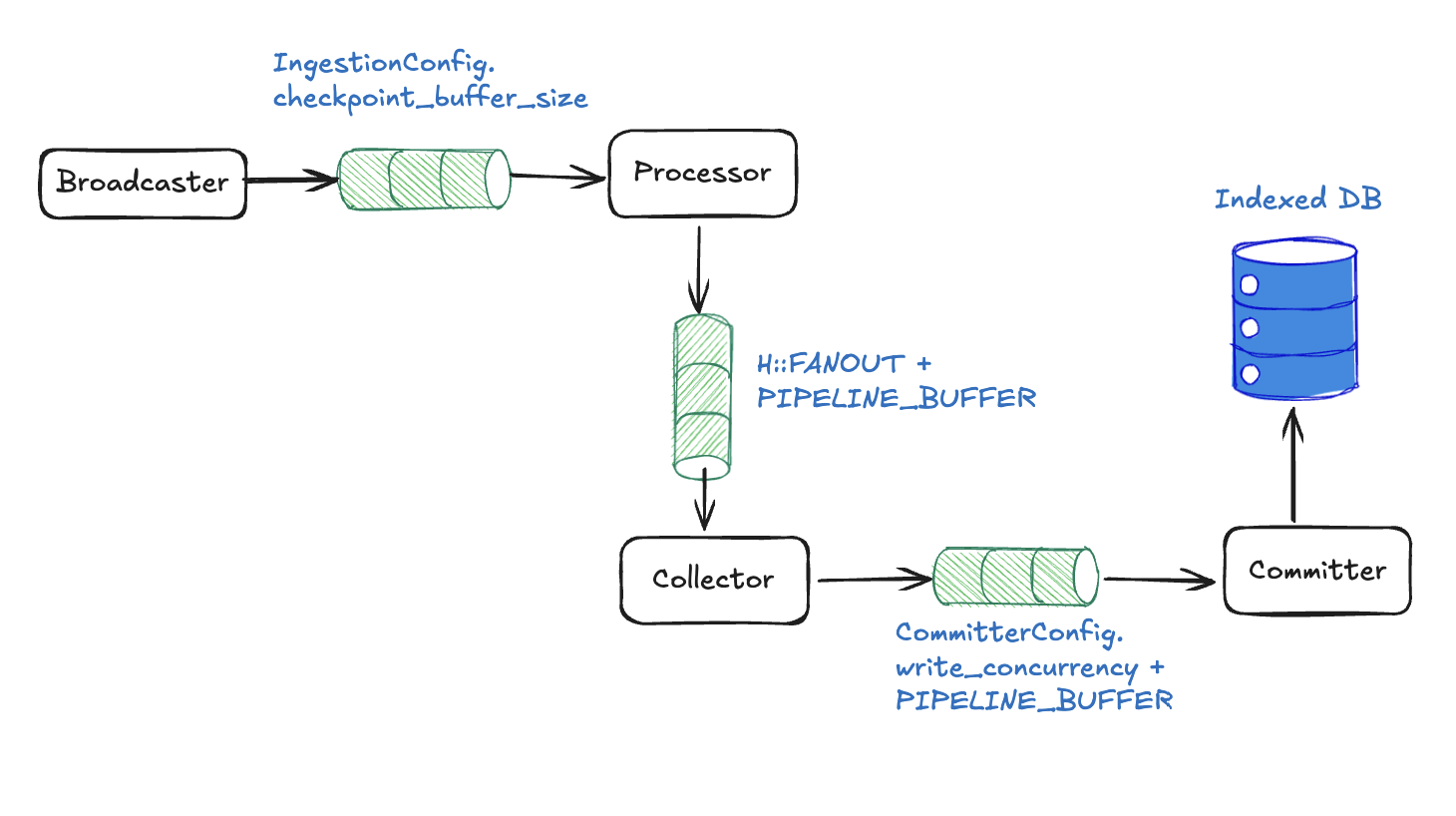
Fixed size를 사용하는 channel-level blocking
각 channel은 가득 차면 자동으로 block되는 fixed buffer size를 가진다:
Broadcaster to Processor: subscriber_channel_size slots → Broadcaster가 block되어 upstream pressure가 생긴다.
/// Per-pipeline ingestion settings.
#[derive(Serialize, Deserialize, Debug, Clone, Default)]
pub struct IngestionConfig {
    /// Capacity of this pipeline's bounded subscriber channel. If `None`, the built-in default
    /// is used (see [`IngestionConfig::subscriber_channel_size`]).
    pub subscriber_channel_size: Option<usize>,
}
Processor to Collector: processor_channel_size slots (num_cpus / 2가 기본값) → 모든 workers가 send()에서 block된다.
let (processor_tx, collector_rx) = mpsc::channel(processor_channel_size);
Collector to Committer: collector_channel_size slots (num_cpus / 2가 기본값) → Collector가 수락을 중단한다.
let (collector_tx, committer_rx) = mpsc::channel(collector_channel_size);
어떤 channel이든 가득 차면 pressure가 전체 pipeline을 통해 자동으로 역방향 전파된다.
Component-level blocking 동작
Component 수준에서 Collector는 memory limits를 준수하며 pending_rows ≥ MAX_PENDING_ROWS일 때 수락을 중단한다.
Some(mut indexed) = rx.recv(), if pending_rows < max_pending_rows => {
    let reader_lo = reader_lo_atomic.load(Ordering::Relaxed);

    metrics
        .collector_reader_lo
        .with_label_values(&[H::NAME])
        .set(reader_lo as i64);

    let mut recv_cps = 0usize;
    let mut recv_rows = 0usize;
    loop {
        if indexed.checkpoint() < reader_lo {
            indexed.values.clear();
            metrics
                .total_collector_skipped_checkpoints
                .with_label_values(&[H::NAME])
                .inc();
        }

        recv_cps += 1;
        recv_rows += indexed.len();
        pending_rows += indexed.len();
        pending.insert(indexed.checkpoint(), indexed.into());

        if pending_rows >= max_pending_rows {
            break;
        }

        match rx.try_recv() {
            Ok(next) => indexed = next,
            Err(_) => break,
        }
    }

    metrics
        .total_collector_rows_received
        .with_label_values(&[H::NAME])
        .inc_by(recv_rows as u64);
    metrics
        .total_collector_checkpoints_received
        .with_label_values(&[H::NAME])
        .inc_by(recv_cps as u64);

    if pending_rows < min_eager_rows {
        continue;
    }
}
Database connection limits도 존재한다. Committer는 모든 connections가 사용 중일 때 block된다.
실제 backpressure 동작
기본 예제: 느린 database 시나리오
- Initial state: indexer가 초당 100개의 checkpoints를 처리하고 있다.
- Bottleneck appears: database가 느려져(높은 부하, maintenance, 또는 유사한 원인) 이제 초당 50개의 commits만 처리할 수 있다.
- Backpressure cascade:
Committerchannel이 가득 찬다(commit을 충분히 빠르게 할 수 없음).Collector가Committer로 보내기를 멈춘다(channel full).Processorchannel이 가득 차고, adaptivefanoutcontroller가 processor concurrency를 minimum 쪽으로 줄인다.Broadcaster는 subscriber channel이 차는 것을 보고 adaptiveingest_concurrencycontroller로 fetch concurrency를 minimum 쪽으로 줄인다. Channel이 capacity에 도달하면 ingest tasks가send에서 block되고 channel이 비워질 때까지 checkpoint ingestion이 멈춘다.
- End 결과:
- Indexer가 자동으로 초당 50 checkpoints로 느려져 database capacity에 맞춰진다.
- Memory는 bounded 상태를 유지하고 runaway growth가 없다.
- 모든 것이 단지 더 느리게 처리될 뿐이므로 data loss가 없다.
- System은 bottleneck pace에서 안정적이다.
- Recovery: database 속도가 다시 빨라지면 channels가 비워지기 시작하고 indexer는 자동으로 full speed로 돌아간다.
발생하는 현상:
- 로그와 metrics에서 checkpoint progress가 느려진다.
- Memory usage는 안정적으로 유지된다(증가 없음).
- System은 responsive한 상태를 유지하지만 throughput이 감소한다.
Performance tuning 조정
다음 섹션에서는 최적의 성능을 위해 구현할 수 있는 configuration settings를 설명한다.
Concurrent pipeline Handler constant 설정
Handler constants는 pipeline behavior를 튜닝하는 가장 직접적인 방법이다. 이는 Handler trait 구현의 associated constants로 구현되며 per-handler defaults 역할을 한다.
impl concurrent::Handler for MyHandler {
    type Store = Db;

    // Minimum rows to trigger eager commit for committer (default: 50)
    const MIN_EAGER_ROWS: usize = 100;

    // Backpressure threshold on collector (default: 5000)
    const MAX_PENDING_ROWS: usize = 10000;

    // Maximum watermarks per batch (default: 10,000)
    const MAX_WATERMARK_UPDATES: usize = 5000;
}
이 constants는 재컴파일 없이 ConcurrentConfig를 통해 runtime에서 override할 수도 있다. Config values가 존재하면 trait constants보다 우선한다.
use sui_indexer_alt_framework::config::ConcurrencyConfig;

let config = ConcurrentConfig {
    committer: committer_config,
    pruner: Some(pruner_config),
    // Adaptive concurrency (default). Starts at 1 and scales up to num_cpus.
    fanout: None,
    // Or use fixed concurrency:
    // fanout: Some(ConcurrencyConfig::Fixed { value: 20 }),
    // Or customize adaptive bounds:
    // fanout: Some(ConcurrencyConfig::Adaptive {
    //     initial: 5,
    //     min: 1,
    //     max: 32,
    // }),
    min_eager_rows: Some(100),
    max_pending_rows: Some(10000),
    max_watermark_updates: Some(5000),
    processor_channel_size: None, // defaults to num_cpus / 2
    collector_channel_size: None, // defaults to num_cpus / 2
    committer_channel_size: None, // defaults to num_cpus

    // Per-pipeline overrides for the ingestion layer's defaults.
    ingestion: pipeline::IngestionConfig {
        // None falls back to the built-in default (max(num_cpus / 2, 4)).
        subscriber_channel_size: None,
    },
};
Tuning guidelines:
fanout: 기본적으로 processor concurrency는 adaptive이며, 1에서 시작해 downstream channel pressure에 따라 CPU 개수까지 확장된다. Controller는 processor-to-collector channel의 fill fraction을 모니터링하고 60%와 85% fill 사이의 dead band를 사용해 concurrency를 조정한다. 이는 fixed concurrency(ConcurrencyConfig::Fixed)로 override하거나 adaptive bounds(ConcurrencyConfig::Adaptive)를 customize해서 사용할 수 있다. 기본 max인num_cpus는 processor가 CPU-bound라고 가정한다. Processor가 IO를 수행한다면(예를 들어 외부 서비스에서 데이터를 가져오는 경우) 더 높은 max가 필요할 수 있다. Adaptive controller는 fill-fraction thresholds를 override하는dead_bandparameter도 제공하지만, 기본값이면 대부분의 workloads에 충분하다.processor_channel_size: processor와 collector 사이 channel의 크기를 제어한다. 기본값은num_cpus / 2이다. 이 channel은 adaptive concurrency controller를 구동하는 signal이기도 하다.collector_channel_size: collector와 committer 사이 channel의 크기를 제어한다. 기본값은num_cpus / 2이다. Committer가 collector보다 더 빨리 batches를 비우는 경우 늘릴 수 있다.committer_channel_size: committer와 watermark updater 사이 channel의 크기를 제어한다. 기본값은num_cpus이다. 드물게만 튜닝이 필요하다.ingestion.subscriber_channel_size: bounded broadcaster-to-processor channel의 capacity이다.None이면 기본값max(num_cpus / 2, 4)를 사용한다. Ingestion bursts에 대한 여유가 더 필요한 pipeline에서 값을 늘린다. 값이 클수록 해당 pipeline은 adaptive ingest controller의 throttling을 다른 pipeline보다 늦게 trigger한다.MIN_EAGER_ROWS: 낮은 값은 data commit latency를 줄이고(개별 data가 database에 더 빨리 나타남), 높은 값은 전체 throughput을 개선한다(더 큰 batches가 더 효율적임).MAX_PENDING_ROWS: committer가 뒤처질 때 얼마나 많은 data가 누적될 수 있는지 제어한다. 높은 값은 더 많은 buffer space를 제공하지만 bottlenecks 동안 더 많은 memory를 사용한다.MAX_WATERMARK_UPDATES: sparse pipelines(드문 events)에서는 낮추고 dense pipelines에서는 기본값을 유지한다.
CommitterConfig optimization 조정
CommitterConfig는 data가 collection에서 database commits로 흐르는 방식을 제어한다:
let config = ConcurrentConfig {
    committer: CommitterConfig {
        // Number of parallel database writers (default: 5)
        write_concurrency: 10,

        // How often collector checks for batches in ms (default: 500)
        collect_interval_ms: 250,

        // How often watermarks are updated in ms (default: 500)
        watermark_interval_ms: 1000,

        // Maximum random jitter added to watermark interval in ms (default: 0)
        watermark_interval_jitter_ms: 100,
    },
    pruner: Some(pruner_config),
    ..Default::default()
};
Tuning guidelines:
write_concurrency: 값이 높을수록 throughput은 빨라지지만 더 많은 database connections가 필요하다.ensure total_pipelines × write_concurrency < db_connection_pool_size.collect_interval_ms: 낮은 값은 latency를 줄이지만 CPU overhead를 높인다.watermark_interval_ms: watermarks가 얼마나 자주 업데이트되는지 제어한다. 값이 높을수록 빈번한 watermark writes로 인한 database contention은 줄지만, indexer가 pipeline progress에 반응하는 속도는 느려진다.
PrunerConfig 설정
Data retention과 pruning performance를 구성한다:
let pruner_config = PrunerConfig {
    // Check interval for pruning opportunities in ms (default: 300,000 = 5 min)
    interval_ms: 600_000, // 10 minutes for less frequent checks

    // Safety delay after reader watermark update in ms (default: 120,000 = 2 min)
    delay_ms: 300_000, // 5 minutes for conservative pruning

    // How many checkpoints to retain (default: 4,000,000)
    retention: 10_000_000, // Keep more data for analytics

    // Max checkpoints to prune per operation (default: 2,000)
    max_chunk_size: 5_000, // Larger chunks for faster pruning

    // Parallel pruning tasks (default: 1)
    prune_concurrency: 3, // More parallelism for faster pruning
};
Tuning guidelines:
retention: storage costs와 data availability needs 사이의 균형을 맞춘다.max_chunk_size: 값이 클수록 pruning은 빨라지지만 database 트랜잭션는 더 길어진다.prune_concurrency: database connection limits를 초과하지 않도록 한다.delay_ms: safety를 위해 늘리고 aggressive storage optimization을 위해 줄인다.